In short, it means that Planche was a pretty interesting guy.
Let’s review:
THEATER
Planche begins his career as a writer for theater in his early 20s. This leads, within five years, to his work as a theatrical costumier – work for which he has subsequently been recognized as the first to introduce “authentic” historical costuming. Within another five years, his plays become influenced by his interest in antiquarianism. By the time he was in his 40s, Planche was in charge of scenic design at Covent Garden, and in his 50s of the Lyceum. Also in his 50s, Planche was a member of the committee to purchase and preserve Shakespeare’s birthplace. At the end of his life, in 1869 Planche writes Suggestions for a National Theater and performs in a benefit at Haymarket.
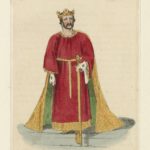
ANTIQUARIANISM
When he’s in his early 30s, Planche is elected a Fellow of the Society of Antiquaries. (Then and now, this is a pretty tough gig to get.) Not too many years before, he had been introduced to Samuel Rush Meyrick, author of Critical Inquiry into Antient Armor, and much, much more. Within another few years he meets Arthur Hallam, whom he calls “the historian of the Middle Ages,” and begins contributing his own articles to archaeological journals. (Planche, 164) In 1843 Horace Walpole’s collection from Strawberry Hill was sold off at auction – a sale that would have been very exciting for the new British Archaeological Association, of which Planche was a founding member. In his 50s, though, Planche resigns from the Society of Antiquaries. Not to worry, he’s almost immediately appointed to the College of Arms as Rouge Croix Pursuivant. When the Meyrick collection is displayed as part of the Art Treasures exhibition in 1857, Planche acts as curator – he repeats this for the 1868 South Kensington exhibition. In 1866 he becomes Somerset Herald.
AUTHOR
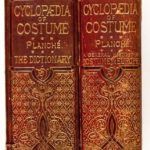
In his adolescence Planche was articled to a bookseller, and his love of books was life-long. His own first book, History of British Costume from the Earliest Period to the Close of the 18th Century (1834), is published before he turns 40. In 1842 Planche edited two volumes of Joseph Strutt’s The Sports and Pastimes of the People of England. With the advent of the British Archaeological Association in 1843 Planche begins submitting regular articles for publication, and then for the journal of the Society of Antiquaries, Archaeologia – this is followed by several books specifically on heraldry. In 1852 Planche publishes The Pursuivant of Arms, or Heraldry Founded upon Facts, dedicated to the current Garter King of Arms, and 1866 revises Hugh Clark’s An Introduction to Heraldry. In the 1870s he begins writing in earnest: Recollections and Reflections, The Conquer and His Companions, and A Cyclopaedia of Costume, or Dictionary of Dress are all two volumes each. In 1871 Planche was awarded a civil-list pension of 100 pounds “in recognition of his literary services.”
TOWER OF LONDON
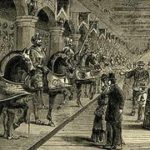
Planche also played a long-term role in the development and presentation of the Tower of London collections. In 1838 the Tower was admitting about 100 visitors per day for 1 shilling apiece – by the next year William Harrison Ainsworth and George Cruikshank published a romantic best seller set at the Tower. In 1841 Parliament suggests developing a catalog for the Tower collection – a project that became very contentious and produced arguments spanning decades. Planche was highly criticial of how the armor was originally presented, and then in 1850 he criticizes the Tower for not buying from Samuel Luke Pratt, who had supplied the armor for the Eglinton Tournament of 1839. By 1855 one of his friends wrote to support Planche’s plan for reorganization of the collection. In 1859, and then again in 1860, Planche himself writes, asking for the job of reorganizing the collection. Finally, by 1868 Planche was invited to reorganize the tower, and in 1869 writes a report to the War Office explaining his reorganization decisions.
NOVIOMAGIANS
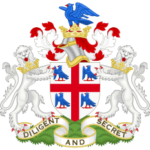
Simultaneous to becoming a Fellow of the Society of Antiquaries (and this is important) he joins the Noviomagians, a private dinner group founded in 1828. Planche joins in 1829, and becomes one of its longest-standing members. The Noviomagians were, essentially, nonsense. I mean that in a very literal way. They were a group of eminent archaeologists and antiquarians who met once a month and entertained each other with faux antiquities, such as an “ancient Irish shield,” actually a trash can lid. (NS 1833, 2:40) Their publication, the Noviologia, preceded Planche’s own History of British Costume by a year, but included bogus articles such as one on the history of thimbles, including eve’s thimble. The group had their own museum, their own coat of arms, and several eminent members.
